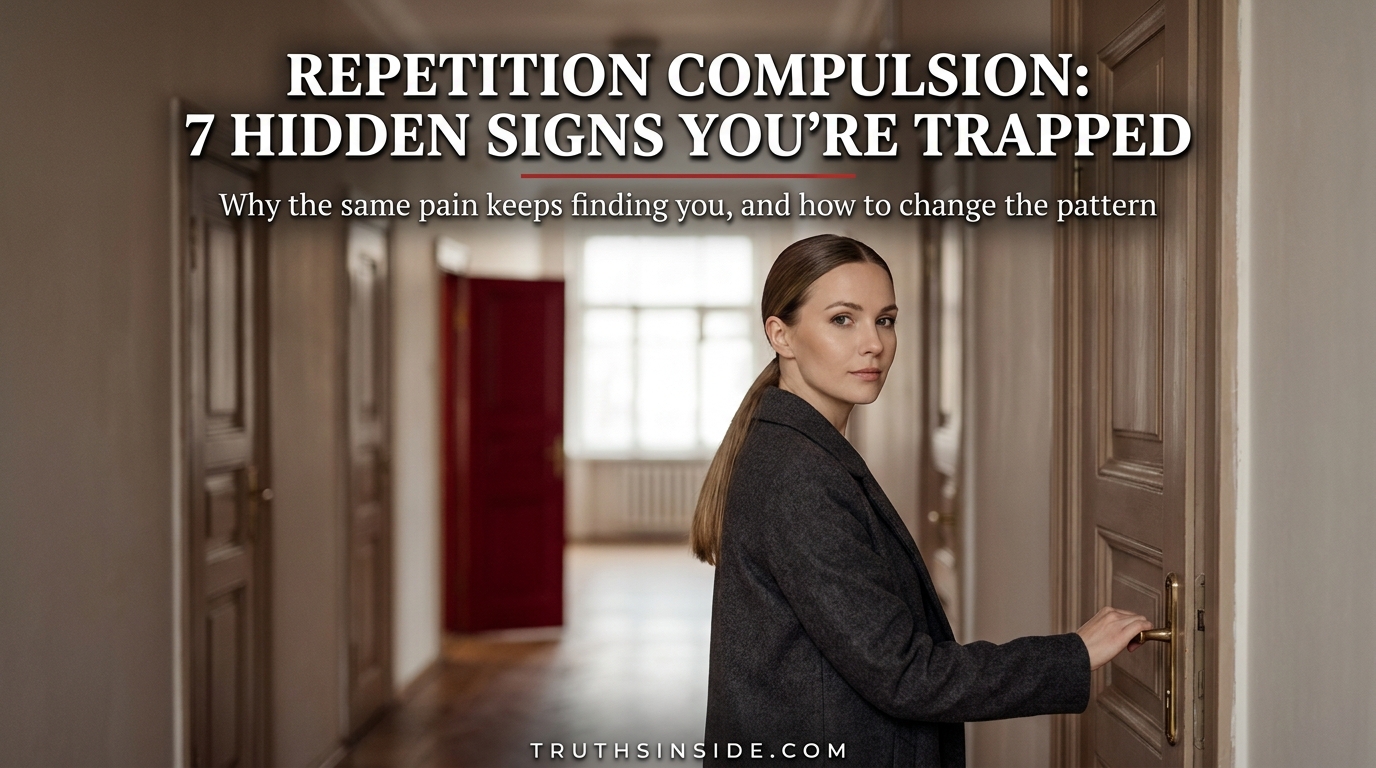
Repetition Compulsion: Why You Unconsciously Recreate Past Pain
Repetition compulsion is the quiet reason you can swear you will never end up in the same situation again, and then find yourself in it anyway. Different person, different city, same feeling in your chest. You notice the pattern halfway through and think, “How did I do this again?” That question is not a sign of weakness. It is the first honest step toward understanding something very human.
Psychologists have been studying this for over a century. Sigmund Freud first described the repetition compulsion in the early 1900s, noting that people tend to replay painful experiences instead of remembering them. More recent research adds a surprising twist: in a 1994 study, psychologist William Swann and colleagues found that people with negative self-views were often more committed to partners who saw them negatively. Familiarity, even painful familiarity, can feel like safety.
In this guide, you will learn what repetition compulsion is, why the mind repeats what hurts, seven signs it may be shaping your life, how it differs from bad luck, and seven practical steps to start breaking the pattern.

What Is Repetition Compulsion?
Repetition compulsion is the unconscious tendency to recreate situations, relationships, or emotional experiences that resemble past pain, especially pain from childhood or earlier relationships. It is not a formal diagnosis. It is a concept from psychoanalysis that therapists across many traditions still use to describe a very recognizable pattern: we keep returning to what hurt us.
Freud introduced the idea in his 1914 paper on remembering, repeating, and working through, and expanded it in “Beyond the Pleasure Principle” in 1920. His observation was that patients often acted out forgotten experiences rather than recalling them. What could not be remembered was repeated, and the repetition happened without the person realizing what they were doing.
Today, many clinicians describe repetition compulsion in more gentle terms. Trauma researcher Bessel van der Kolk wrote about the “compulsion to repeat the trauma,” noting that many survivors unconsciously reenact aspects of what happened to them. Importantly, this is not a choice or a character flaw. It is a pattern the mind falls into without awareness, often while genuinely trying to avoid the very outcome it recreates.
📃 Related article: Holding Grudges: 7 Toxic Ways It Destroys Love
Why the Mind Repeats What Hurts
If repetition compulsion causes so much pain, why does it persist? Several explanations from psychology work together, and each makes the pattern a little less mysterious.
Familiarity feels like home. The nervous system prefers what it knows. If your early relationships involved criticism, distance, or unpredictability, those qualities may feel natural, even when they hurt. Calm and consistent treatment can feel strange, boring, or suspicious by comparison.
The urge to master. Some psychologists suggest we repeat painful scenes in the hope of finally changing the ending. If you could not win a parent’s approval as a child, you might unconsciously choose partners who are hard to please and try, again, to earn it.
Self-verification. William Swann’s research shows that people want others to see them as they see themselves, even when that view is negative. If you believe you are unlovable, being treated as unlovable can feel oddly consistent, and kindness can feel like a mistake.
Unfinished emotional business. Feelings that were never processed tend to look for a place to land. New relationships can become a stage for old grief, anger, or longing.
Internal working models. John Bowlby’s attachment theory describes the mental blueprints we build from early relationships. These expectations quietly steer our choices, often without our noticing.
The mind does not repeat pain because it enjoys it. It repeats pain because it recognizes it.
7 Signs Repetition Compulsion May Be Shaping Your Life
Seeing the pattern is the hardest part, because it rarely feels like a pattern from the inside. It feels like fate, bad luck, or “just my type.” Here are seven signs worth examining with curiosity rather than blame.
1. You Keep Choosing the Same Kind of Person
You might notice that every partner shares the same trait: emotionally unavailable, critical, unpredictable, or in need of rescuing. The faces change, but the dynamic feels strikingly similar. Friends may point it out before you do.
This is one of the most common expressions of repetition compulsion. Without realizing it, you may be drawn to people who echo an earlier caregiver, because the dynamic feels like chemistry. Psychologist Jeffrey Young, founder of schema therapy, calls this “schema chemistry,” the powerful pull toward what confirms an old belief.
2. You Have the Same Fight With Different People
Whether it is “You never listen,” “You do not care,” or “You always leave,” the words may repeat across relationships. The topics change, but the emotional core is identical. Each argument ends in the same place: you feel unseen, controlled, or abandoned.
When the same fight appears with different partners, repetition compulsion is a more likely explanation than coincidence. The common factor is the part of you that responds in a familiar way, such as pursuing, withdrawing, or shutting down, which tends to invite a familiar response.
3. Calm Feels Boring and Chaos Feels Like Chemistry
If you have ever walked away from a kind, steady person because “there was no spark,” you may recognize this sign. Anxiety, uncertainty, and intensity can be mistaken for passion, especially if love at home came with unpredictability.
The nervous system learns to equate excitement with attachment. As a result, repetition compulsion can make stable relationships feel flat and turbulent ones feel alive. It takes time for a body used to alarm to recognize peace as safety.
4. You Slip Into a Role Automatically
Perhaps you become the caretaker who solves everyone’s problems, the peacemaker who swallows every need, or the rebel who pushes against any hint of control. These roles often come from childhood, where they helped you survive or stay close to someone important.
In adulthood, they can lock you into painful dynamics. You may attract people who need rescuing, or who take more than they give. Repetition compulsion pulls you back into a role long after it has stopped serving you.
5. You Test, Push, or Sabotage to Prove the Old Belief
If you expect people to leave, you may unconsciously create the conditions that make them do so. You might pick fights, withdraw, or demand constant reassurance. When the relationship ends, a painful part of you thinks, “I knew it.”
This is repetition compulsion working through a self-fulfilling prophecy. The goal is not to be abandoned. It is to avoid the shock of being surprised by it. Swann’s work on self-verification helps explain why even a hurtful confirmation can feel more bearable than uncertainty.
6. The Pattern Shows Up Beyond Romance
Repetition compulsion is not limited to love. You may notice the same dynamics with bosses, friends, or family: a critical manager who echoes a harsh parent, a friend who always takes more than they give, or a team where you always end up doing the invisible work.
Look for the common thread. If your career, friendships, and relationships all contain the same plot, that is information. It points to something internal that travels with you, not just to external circumstances.
7. You Feel Déjà Vu, a Sense of “Here We Go Again”
Many people describe a moment when a new situation suddenly feels uncannily familiar. The tone of a voice, a silence, or a certain look sends your body into a response that seems bigger than the moment. Your heart races, your stomach drops, and an old script begins.
That feeling is your body recognizing the pattern. Repetition compulsion often shows up first as a physical sensation, before you can put it into words. Learning to notice it is one of the most valuable skills in changing the pattern.

Repetition Compulsion vs. Bad Luck vs. Being Targeted
It is important to be careful here. Not every painful repeat is caused by unconscious patterns, and no one deserves to be mistreated. Some people are targeted by manipulative or abusive partners who seek out kindness and vulnerability. In those cases, the responsibility belongs to the person causing harm.
Repetition compulsion helps explain why you might feel drawn to certain dynamics, and why leaving can be so hard. It does not mean you caused what happened. Understanding the pattern is about gaining choices, not assigning blame.
Here are a few questions that can help you tell the difference:
- Does the same emotional dynamic keep appearing, even when the people differ?
- Do you notice a familiar feeling in your body early in each new relationship?
- Do you find yourself in the same role every time?
- Do friends or family notice the pattern before you do?
- Does calm or kindness make you uneasy?
If you are in a relationship where you feel afraid, controlled, or unsafe, please reach out for support. The National Domestic Violence Hotline is available at 1-800-799-7233, or you can text START to 88788. In immediate danger, call 911.
Where Repetition Compulsion Comes From
The roots of repetition compulsion usually trace to early experiences, but they can also come from later events. Childhood is a common origin. Children are wired to adapt to the emotional climate around them. If love came with conditions, unpredictability, or distance, a child learns strategies to cope: people-pleasing, withdrawal, perfectionism, or constant vigilance.
Trauma can also play a central role. Judith Herman, in her book “Trauma and Recovery,” describes how survivors may unconsciously reenact aspects of past harm in new relationships. This can happen in subtle ways, such as picking partners who feel dangerous, or in more direct ways, such as recreating feelings of helplessness.
Culture and family systems matter, too. Patterns often travel through generations. Psychiatrist Murray Bowen’s family systems theory suggests that unresolved emotional issues in one generation tend to reappear in the next. You may be repeating something that is much older than you.
📃 Related article: Template for Love: 7 Shocking Ways Parents Shaped You
What Repetition Compulsion Feels Like in the Body
Because the pattern begins before words, it often shows up as sensation. You might notice a tight chest, a knot in your stomach, shallow breathing, a sudden urge to flee, or a wave of numbness. These are signals that your body has recognized something familiar.
Paying attention to these sensations can be more informative than any explanation. When your reaction feels bigger than the situation, ask yourself, “How old do I feel right now?” The answer is often a clue to the original scene.
This is also why insight alone rarely solves repetition compulsion. Understanding the pattern with your mind is important, but the body needs new experiences to learn that the old alarm no longer applies.
You cannot think your way out of a pattern your body learned. But you can feel your way into a new one.
7 Steps to Break the Cycle of Repetition Compulsion
Changing the pattern takes patience and kindness toward yourself. These steps can help you begin.
- Map the pattern. Write down your last three significant relationships or conflicts. Note how they began, what happened in the middle, and how they ended. Look for the common threads.
- Find the original scene. Ask what your earliest memory of this feeling is. You do not need to relive it. Simply naming where it began can loosen its hold.
- Name your role. Are you the rescuer, the pursuer, the avoider, the pleaser? Seeing your habitual part helps you choose a different one.
- Pause in the moment. When you feel the familiar rush, slow down. Take a breath, feel your feet on the ground, and give yourself ten seconds before reacting.
- Run small experiments. Do one thing differently: say a need out loud, wait before replying, stay when you would normally leave. Small changes teach the nervous system new outcomes.
- Seek corrective experiences. Spend time with people who are consistent, kind, and honest. Over time, safe relationships help rewrite old expectations.
- Get professional support. Therapies that address repetition compulsion include psychodynamic therapy, schema therapy, attachment-based therapy, EMDR, and somatic approaches. A licensed therapist can help you choose.
A Simple Exercise: The Pattern Timeline
Set aside thirty minutes and a notebook. Draw a line across the page and mark key relationships, jobs, or conflicts along it. Under each one, write three things: what drew you in, what went wrong, and how you felt at the end.
Then look for repeats. Does the same feeling appear at the start? Does the same fear show up at the end? What role did you play each time? Finally, write one sentence about what you would like to do differently next time.
Many people are surprised by what they see. Pattern timelines make repetition compulsion visible, and visibility is where choice begins. Share the timeline with a therapist or trusted friend if you can.
Can Repetition Compulsion Be Healed?
Yes. Repetition compulsion is a pattern, not a sentence. Psychologists describe the process of “earned security,” in which adults with difficult histories develop more secure ways of relating through insight, therapy, and safe relationships. The mind that learned to repeat can also learn something new.
Healing rarely looks like a dramatic breakthrough. More often it shows up as small shifts: noticing the pattern sooner, recovering faster, choosing a different partner or a different response. Each time you respond differently, you teach your nervous system that the old story does not have to repeat.
Expect setbacks. Slipping into an old pattern does not mean you are failing. It means the pattern is old and strong, and you are learning to meet it with more awareness than before.

When to Seek Professional Help
Consider speaking with a licensed therapist if the same painful pattern keeps appearing, if your reactions feel overwhelming, or if you recognize trauma in your history. Therapy is especially helpful for repetition compulsion because it offers a new relationship, one that is consistent and safe, where old patterns can be noticed and changed.
If you are in crisis or thinking about harming yourself, please reach out right away: in the United States, call or text 988, the Suicide & Crisis Lifeline, at any time.
FAQ: Repetition Compulsion
What is repetition compulsion in psychology?
Repetition compulsion is the unconscious tendency to recreate situations or emotional experiences that resemble past pain, often from childhood. Freud first described it, and many therapists still use the concept to explain why people repeat painful patterns in relationships.
Why do I keep dating the same type of person?
Familiarity can feel like chemistry. If your early relationships involved distance, criticism, or unpredictability, your nervous system may recognize those qualities as home. Repetition compulsion pulls you toward what feels known, even when it hurts.
Is repetition compulsion the same as trauma bonding?
They are related but different. A trauma bond is an attachment to a specific person formed through cycles of harm and kindness. Repetition compulsion is a broader tendency to recreate patterns across relationships. They can overlap.
Can you stop repetition compulsion without therapy?
Some people make progress through self-reflection, journaling, and supportive relationships. But because the patterns are often unconscious, therapy can speed the process and make it safer, especially when trauma is involved.
How long does it take to break the pattern?
There is no fixed timeline. Many people notice small shifts within months, such as catching reactions faster, while deeper change may take years. Progress is usually uneven, with setbacks along the way.
Final Thoughts
Repetition compulsion is not proof that you are broken. It is proof that your mind has been trying, in its own confusing way, to resolve something that still matters. By noticing the pattern, naming it, and slowly practicing something new, you can turn a cycle into a choice. The past may have written your first draft, but you are allowed to write the next chapter.
Save this article for the moment you catch yourself saying, “Here we go again.” Share it with someone who is tired of repeating the same story. Follow Truthsinside.com for more honest insight into relationships and psychology.
🎵 Music
Maren Lull is a singer-songwriter who writes from the places most people don’t talk about out loud.
Not the dramatic grief. Not the obvious heartbreak. The quiet kind — the ordinary Tuesday emptiness, the habit of reaching for someone who isn’t there anymore, the particular exhaustion of being strong for so long that the strength itself wears thin.
Her music lives at the intersection of emotional honesty and soft beauty — breathy vocals over gentle piano, slow tempos, lyrics that feel less like songs and more like something you wrote in a private notebook at two in the morning and never showed anyone.
Maren Lull writes for the people who feel everything deeply and say very little about it. For the ones who listen to sad music not because they want to feel worse — but because being understood, even by a song, makes the feeling easier to carry.
📱 Follow Maren Lull:
→ Spotify
→ Apple Music
→ Youtube
→ Audiomack