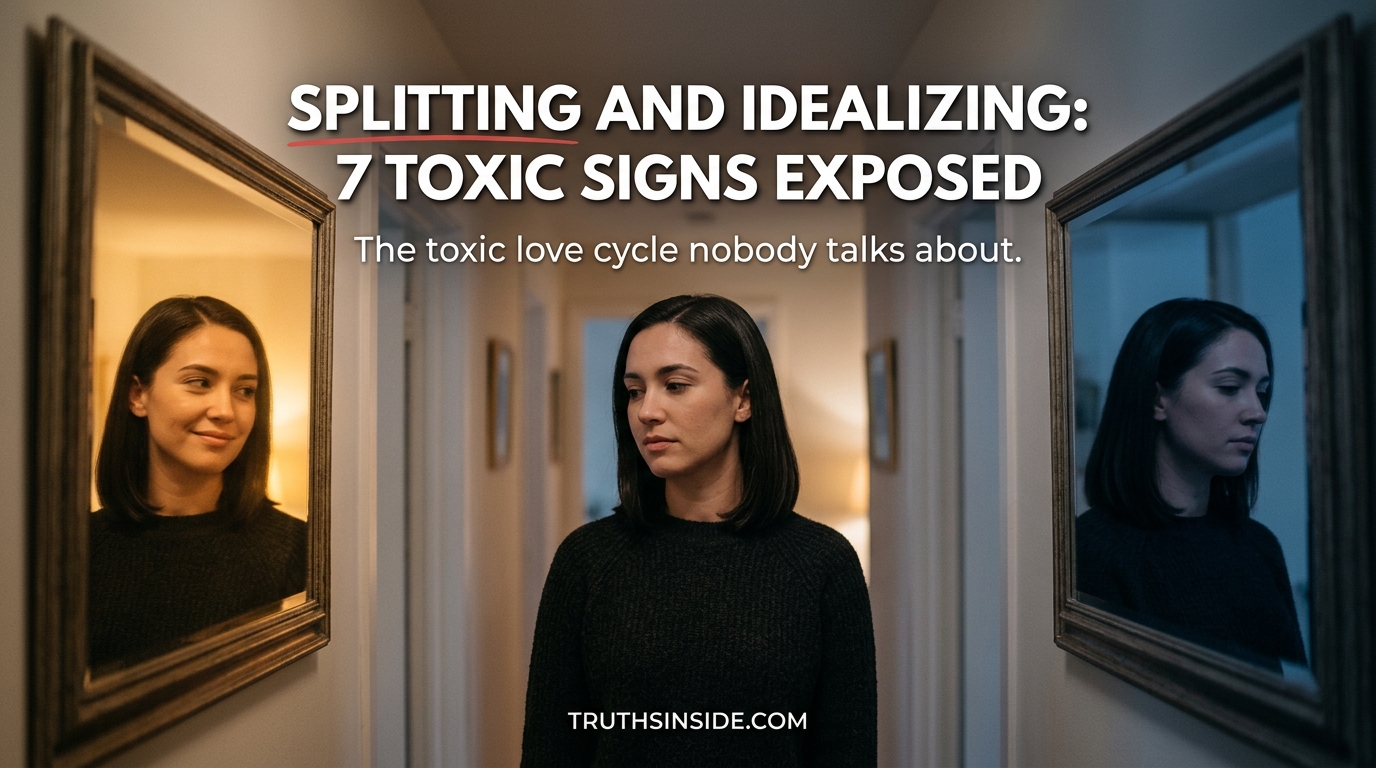
Splitting and Idealizing: The Toxic Love Cycle Nobody Talks About
One week, you are the best thing that ever happened to them. The next, you are the worst. Nothing about you changed, yet the way they see you flipped overnight. If you have lived through this, you have met splitting, and it can leave you dizzy, doubting yourself, and afraid to say the wrong word.
Splitting is a psychological defense in which a person sees people, situations, and even themselves as all good or all bad, with no middle ground. The idea traces back to psychoanalysts such as Melanie Klein and Otto Kernberg, and it is most often discussed in connection with borderline personality disorder (BPD), which research suggests affects roughly 1.6 percent of U.S. adults, though estimates vary. The pattern is not limited to any one diagnosis, and having it does not make someone a villain.
This guide explains how splitting and idealizing work, why the cycle feels like love at first and cruelty later, seven toxic signs to recognize, and what you can do whether you are the person on the pedestal, the person who fell off it, or the person who does the splitting.

What Is Splitting in Psychology?
In everyday terms, splitting is black-and-white thinking applied to people. A person is a hero or a villain, a soulmate or an enemy, a saint or a traitor. The mind struggles to hold two opposite truths together, such as “I love you” and “I am angry at you,” so it keeps them in separate boxes and switches between them.
Researchers describe splitting as a defense against overwhelming emotion. Holding mixed feelings about someone you depend on can feel unbearable to a mind that never learned to tolerate ambivalence. This defense protects against that discomfort, but it costs the relationship its stability. A person who is seen as perfect today has nowhere to go but down tomorrow.
It helps to remember that this usually happens below conscious awareness. Most people who do it are not plotting to hurt anyone. They are trying to manage feelings that seem too big to survive.
📃 Related article: Repetition Compulsion: 7 Hidden Signs You’re Trapped
Idealizing and Devaluing: The Two Faces of Splitting
Splitting has two sides. Idealizing places someone on a pedestal. Devaluing pulls them down and treats them as worthless or dangerous. Together they form the engine of the toxic love cycle.
Idealizing sounds like: “You are perfect.” “You understand me like nobody else.” “I have never felt this way before.”
Devaluing sounds like: “You are just like everyone else.” “I cannot believe I trusted you.” “You never cared.”
The tricky part is that idealizing feels wonderful. Being adored, texted constantly, and told you are rare can feel like the love you always wanted. That is why splitting and idealizing are so hard to spot early, and why so many people stay long after the devaluing begins.
The Toxic Love Cycle: How Splitting Plays Out
Most relationships shaped by this pattern follow a recognizable loop. It does not happen in every case, and it can be milder or more intense, but the pattern often looks like this.
Stage 1: Idealization. Intense closeness arrives fast. There are grand declarations, constant contact, and the sense that you have found someone who truly sees you.
Stage 2: A trigger. A small disappointment appears: a late reply, a forgotten detail, a different opinion. To a mind prone to this defense, this can feel like proof of abandonment or betrayal.
Stage 3: Devaluation. The pedestal collapses. Criticism, coldness, anger, or withdrawal replaces warmth. You may feel like you are suddenly talking to a different person.
Stage 4: Repair or rupture. Sometimes there is a tearful apology and a return to closeness. Sometimes the person pulls away or ends things. Then the loop starts again.
The cruelest part of splitting is not the anger. It is the memory of how good it felt before the fall.
Why Splitting Happens
No single cause explains it, but several factors often appear together.
Early attachment wounds. Children who experience unpredictable or frightening caregiving may not learn that people can be both loving and flawed. The defense becomes a way to stay safe: keep the “good” separate from the “bad.”
Difficulty regulating emotion. Some people feel emotions faster and more intensely and take longer to settle. Research on BPD has repeatedly linked it to emotional sensitivity and trouble calming down after distress.
Fear of abandonment. When rejection feels like a threat to survival, the mind scans for signs of leaving, and a small slip can set off a flood of fear and anger.
Trauma and stress. Past trauma can make the brain quicker to see danger, which feeds all-or-nothing thinking.
None of this excuses harmful behavior. Understanding why it happens helps you respond with clarity rather than self-blame, and it opens the door to change.
7 Toxic Signs of Splitting and Idealizing
Here are seven signs that this pattern may be shaping a relationship. One or two does not prove anything. A strong, repeating pattern is what matters.
1. Love Bombing at the Start
The relationship moves at lightning speed. You hear “soulmate” within weeks, receive constant messages, and feel swept away. Intensity is mistaken for intimacy, and the cycle thrives on that intensity because the higher you are lifted, the farther you can fall.
2. You Are Either Perfect or Terrible
There is rarely a normal “good enough” middle. You are the hero or the villain. Even small mistakes, like being ten minutes late, can shift you from adored to disappointing in seconds.
3. Sudden, Unexplained Shifts
The change seems to come out of nowhere. You search your memory for what you did wrong and cannot find it. In this pattern, the shift often has more to do with an internal emotional state than with anything you actually did.
4. Other People Get Split Too
Pay attention to how they talk about friends, exes, coworkers, and family. If everyone is either an angel or a monster, and the list changes often, this is likely operating beyond your relationship.
5. Fear of Abandonment Drives the Drama
Reassurance never seems to be enough. A single unanswered text can spark panic, accusations, or testing behaviors. The fear is real to them, even when the danger is not.
6. You Feel Like You Are Walking on Eggshells
You edit your words, hide your needs, and brace for the next flip. Many partners describe feeling as though they are constantly auditioning for a role they cannot keep.
7. Repair Never Leads to Real Change
Apologies and tender reconciliations feel sincere, and often are. But without new skills or support, the same cycle returns. The pattern repeats because the underlying pattern has not been addressed.

What Splitting Feels Like From the Inside
It is easy to cast the person who splits as a villain, but many describe it very differently. They report feeling flooded, desperate, and ashamed. In the moment, the “bad” view of you feels completely true, not like an opinion. Only later, when the wave passes, does the guilt arrive.
This does not make the hurt any smaller for the other person. But it helps explain why simply telling someone to “stop overreacting” rarely works. It is not a choice made at a calm moment. It is a reflex that needs new tools, practiced over time.
Splitting Is Not the Same as Normal Ups and Downs
Every couple argues, and everyone idealizes a new partner a little. The question is how extreme, how fast, and how often the swings happen. Consider these differences.
| Healthy Conflict | Splitting |
|---|---|
| You are annoyed, but still seen as a whole person | You are suddenly seen as all bad |
| Anger fades and warmth returns naturally | Warmth returns only after intense drama |
| Disagreements stay about the issue | Disagreements become attacks on your character |
| Feelings are proportionate to the event | Reactions feel far larger than the trigger |
| Both people can see shades of gray | Everything is love or hate |
If the right-hand column sounds familiar, it may be time to look closer at the pattern.
How Splitting and Idealizing Affect the Person on the Receiving End
Living inside this cycle takes a toll. Many people develop anxiety, self-doubt, and a sense of losing their identity. Because the good times are so good, they hold on, hoping the “real” person will return and stay.
Common effects include:
- Constant hypervigilance, scanning for mood changes
- Self-blame, believing you could fix it by being perfect
- Isolation from friends who do not understand
- Exhaustion from emotional whiplash
- A shrinking sense of your own needs and opinions
If this sounds like your life, it is not weakness. It is a normal response to an unpredictable environment.
If You Love Someone Who Uses Splitting
You cannot cure someone else, but you can respond in ways that lower the heat and protect yourself. Here are practical steps.
Stay calm and steady. When someone is devaluing you, arguing about who is right usually fuels the fire. Speak slowly, keep your voice even, and avoid defending yourself point by point.
Validate the feeling, not the accusation. You can say, “I can see you are really hurt right now,” without agreeing that you are the villain they describe.
Set clear, kind boundaries. For example: “I want to keep talking, but I will step away if we start yelling. We can come back in an hour.” Then follow through.
Do not take the devaluing as the full truth. Their view of you in the middle of a split is a snapshot of their distress, not an accurate portrait of who you are.
Encourage professional help, without ultimatums. Suggest therapy as something that could help both of you feel safer, rather than as proof that something is wrong with them.
Get your own support. A therapist, a trusted friend, or a support group gives you a stable place to check your reality.
If You Recognize Splitting in Yourself
Reading this may stir up shame. If you see yourself in these patterns, notice that awareness is the first real step toward change. People who work on it often make meaningful progress.
Some approaches that clinicians use include:
- Dialectical behavior therapy (DBT): developed by Marsha Linehan, it teaches skills for tolerating distress, regulating emotions, and communicating. It was designed with BPD in mind and has strong research support.
- Mentalization-based therapy: helps you notice your own and others’ mental states without jumping to conclusions.
- Schema therapy: works on the deep beliefs formed early in life.
Everyday practices can help too. When you feel the pull to flip, try pausing for ten slow breaths before responding. Ask yourself, “What else could be true here?” Practice the phrase “both can be true”: “I am hurt, and they still care about me.” Over time, this loosens the grip of the pattern.
Moving From Black-and-White to Both/And
The antidote is not forcing yourself to feel calm. It is learning to hold complexity. Here is a simple exercise.
Step 1: Write down the “all bad” thought. For example: “They never care about me.”
Step 2: Write three facts that do not fit that thought. For example: “They brought me soup last week.”
Step 3: Rewrite the thought in both/and form: “I feel hurt right now, and they have shown they care in other ways.”
Repeat this when emotions run high. It will not feel natural at first, but each repetition builds the mental muscle that this defense leaves underdeveloped.

When Splitting Becomes Unsafe
Splitting is not the same as abuse, but the two can overlap. Warning signs include threats, intimidation, controlling behavior, physical aggression, or any situation where you feel afraid. Intense emotion is never a license to hurt someone.
If you are in danger, your safety comes first. In the United States, the National Domestic Violence Hotline is available at 1-800-799-7233, or you can text START to 88788. If you or someone you love is thinking about suicide or self-harm, call or text 988 at any time. Splitting-related relationships can involve crises, and reaching out for help is a sign of strength.
📃 Related article: Template for Love: 7 Shocking Ways Parents Shaped You
Can Splitting Change?
Yes. Research on BPD, the diagnosis most associated with it, has found that many people improve substantially over time, and long-term studies suggest a large share no longer meet criteria after several years. Therapy helps, and so does a supportive environment.
Change takes patience. Setbacks are common, and healing rarely moves in a straight line. What matters is the overall direction: more awareness, more skills, and a growing ability to stay connected during conflict. If the person is willing to do the work, the relationship may be able to grow into something steadier. If they are not, you are still allowed to protect your peace.
Should You Stay or Leave?
There is no universal answer. Consider these questions:
- Is the person aware of the pattern and willing to get help?
- Do the good periods include real respect, or only intensity?
- Are you losing your sense of self, health, or safety?
- Have boundaries been respected over time?
- Do you feel more anxious than secure most of the time?
If you decide to stay, commit to boundaries and support. If you decide to leave, plan carefully, especially if emotions run high, and lean on people you trust. Leaving a relationship shaped by this cycle can be painful because you may miss the idealized version. Grieving that loss is normal.
When to Seek Professional Help
Consider speaking with a licensed therapist if you feel constantly on edge, if you are doubting your own reality, if conflict keeps escalating, or if you notice this in your own thinking. A professional can offer an assessment and a plan. Couples therapy can help in some situations, but if there is abuse or fear, individual support is safer first.
Frequently Asked Questions About Splitting
What is splitting in a relationship?
Splitting is a defense mechanism where someone sees their partner as all good or all bad, with little room for shades of gray. It often causes sudden swings between adoration and anger, and it can leave both people feeling confused and exhausted.
Is splitting the same as BPD?
No. Splitting is strongly associated with borderline personality disorder, but it can also appear in other conditions, in trauma responses, or during periods of intense stress. Only a qualified professional can diagnose BPD.
Is splitting a form of manipulation?
Not usually in the strategic sense. Most of the time it is an automatic emotional reaction rather than a calculated plan. That said, the impact can still be harmful, and the behavior still needs to be addressed.
Can a person stop splitting?
Yes, with time, awareness, and treatment such as DBT, many people learn to reduce it and build steadier relationships.
How do I respond when my partner starts splitting?
Stay calm, validate the feeling without accepting the blame, set a gentle boundary, and step away if things escalate. Afterward, discuss it when both of you are calm.
Final Thoughts
Splitting and idealizing can make love feel like a roller coaster: breathtaking highs, terrifying drops, and a constant fear of the next fall. Understanding the cycle will not erase the pain, but it gives you language, clarity, and options. Whether you are trying to heal your own patterns or protect yourself from someone else’s, remember that you deserve a love that sees you as a whole person, flaws and all, on good days and bad.
💾 Save this guide for the next time the cycle feels confusing.
📤 Share it with someone who needs words for what they are living through.
➕ Follow Truthsinside.com for more honest relationship and psychology insights every week.
🎵 Music
Maren Lull is a singer-songwriter who writes from the places most people don’t talk about out loud.
Not the dramatic grief. Not the obvious heartbreak. The quiet kind — the ordinary Tuesday emptiness, the habit of reaching for someone who isn’t there anymore, the particular exhaustion of being strong for so long that the strength itself wears thin.
Her music lives at the intersection of emotional honesty and soft beauty — breathy vocals over gentle piano, slow tempos, lyrics that feel less like songs and more like something you wrote in a private notebook at two in the morning and never showed anyone.
Maren Lull writes for the people who feel everything deeply and say very little about it. For the ones who listen to sad music not because they want to feel worse — but because being understood, even by a song, makes the feeling easier to carry.
📱 Follow Maren Lull:
→ Spotify
→ Apple Music
→ Youtube
→ Audiomack