You know the feeling before you know the words for it. Someone says something that sounds like a compliment, and for half a second you smile — and then something in your stomach quietly drops. That delayed sting, the one that makes you replay the sentence three times before you can name what just happened, has a name: a backhanded compliment. Psychologists who study covert communication estimate that most adults experience this exact moment of confusion at least once a week, often without ever identifying the pattern behind it.
A backhanded compliment is not clumsy phrasing. It is not a joke that landed wrong. Research on passive-aggressive communication, including work published in the Journal of Social and Personal Relationships, shows that this style of speech is frequently a deliberate — if unconscious — strategy for delivering criticism while keeping deniability intact. The speaker gets to wound you and still call themselves kind.
This article breaks down exactly what a backhanded compliment sounds like, why it works on even the most emotionally intelligent people, and how to recognize it as the early warning sign it actually is — before it reshapes how you see yourself.
What a Backhanded Compliment Really Sounds Like
A backhanded compliment always has two layers. The surface layer sounds generous. The underlying layer carries the actual message, and the actual message is almost never kind. “You’re so brave for wearing that” is not a compliment about courage — it is a comment about how the outfit looks. “I’m surprised you pulled that off” is not admiration — it is a quiet accusation that you weren’t expected to succeed.
What makes a backhanded compliment so disorienting is its structure. It borrows the tone, rhythm, and vocabulary of genuine praise, which is exactly why your brain initially files it as a positive interaction. Only afterward, once the words settle, does the second layer surface. This delay is not an accident of language. It is the mechanism that makes a backhanded compliment so effective at avoiding confrontation — by the time you feel hurt, the moment has already passed, and calling it out retroactively can feel disproportionate or paranoid, even though your instinct was correct.
Once you start listening for it, a backhanded compliment shows up everywhere: in family dinners, performance reviews, first dates, group chats. It hides inside phrases like “for someone your age,” “I never would have guessed,” and “at least you tried.” Each one performs warmth while delivering judgment.
📃 Related article: Just Protective: 8 Alarming Signs It Was Actually Control
The Psychology Behind Every Backhanded Compliment
A backhanded compliment usually comes from one of three places, and understanding which one you’re dealing with changes how seriously you should take it. The first is insecurity — the speaker feels threatened by your success, appearance, or confidence, and softens their discomfort by wrapping it in praise. The second is habitual criticism, often learned in childhood homes where love and correction were fused together, so the person genuinely believes they are being supportive even as they undercut you. The third, and the one most worth watching for, is control.
In relationships where one partner uses subtle undermining as a tool, a backhanded compliment functions almost identically to intermittent reinforcement — the same psychological mechanism that keeps people hooked on slot machines. You get just enough approval to stay engaged, and just enough doubt to stay working for more. Attachment researchers, including those building on the work of psychologist John Bowlby, have noted that this unpredictable mix of affection and criticism can create a stronger emotional bond than consistent kindness alone, which is precisely why a backhanded compliment from a romantic partner can feel so difficult to walk away from.
“A backhanded compliment doesn’t just criticize you in the moment — it teaches you to doubt your own read of a room. That’s the real damage.”
This is the part most people miss: a single backhanded compliment is rarely the problem. It’s the pattern. One instance can be a slip. A pattern is a relationship strategy, and it deserves to be treated like one.
Backhanded Compliment Red Flags in Relationships
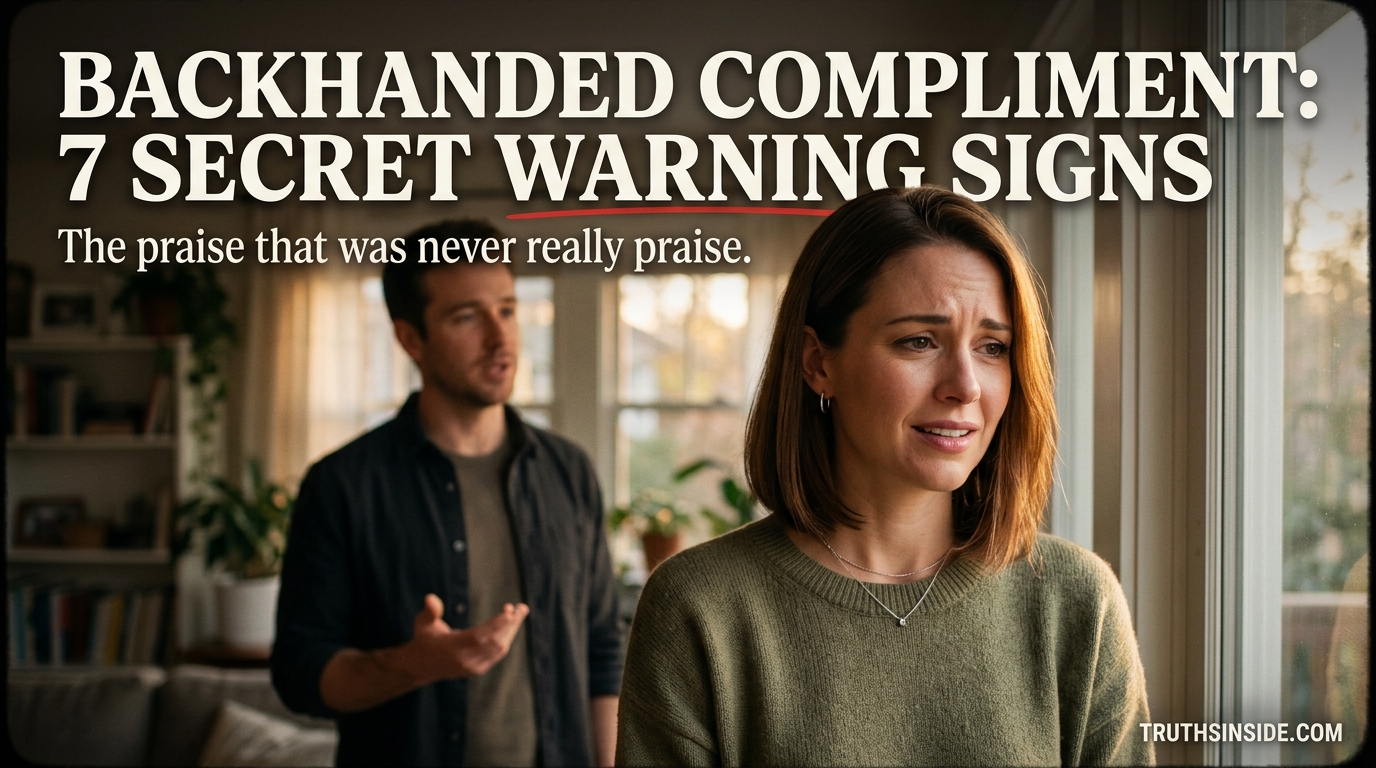
In romantic relationships, a backhanded compliment often escalates slowly, which is exactly what makes it dangerous. Early on, it might sound almost sweet — “I like that you don’t care what people think, most girls are so high-maintenance.” It draws a comparison, positions you as the exception, and subtly criticizes an entire group in the process. It feels flattering because it’s designed to.
Over months or years, the same pattern of backhanded compliment can shift from comparisons to appearance to intelligence to your relationships with other people. “You’re actually pretty smart for someone who didn’t finish college” targets your education. “I’m glad you’re not like your mom, she was always so dramatic” targets your family. Each one lands as praise on the surface and erosion underneath, and because they’re spaced out, they rarely trigger the alarm a direct insult would.

If you find yourself mentally defending your partner’s comment to yourself — “they didn’t mean it that way,” “I’m probably overreacting” — pay attention to how often you’re doing that math. Relationship therapists who specialize in covert emotional abuse point out that the frequency of self-justification is often a more reliable red flag than the comment itself. A healthy partner’s words rarely require you to build a case for their kindness after the fact.
Backhanded Compliment Patterns at Work and Family
Romantic partners aren’t the only source. A backhanded compliment shows up constantly in professional settings, often disguised as feedback. “This is really good, I’m shocked you did it without help” praises the output while questioning your competence. “You’re so organized for someone in your role” flatters while implying your role doesn’t usually attract organized people. Workplace psychologists have documented that women and people from marginalized groups report receiving this style of comment at significantly higher rates, often tied to unconscious bias about who is “supposed” to be capable.
Family relationships carry their own version, usually rooted in decades of established roles. A parent who says “I’m proud of you, even though this isn’t what I would have chosen” is delivering conditional approval disguised as unconditional support. A sibling who says “you look great, did you finally start taking care of yourself?” folds an insult about your past into praise about your present. Because family dynamics are long-standing, a backhanded compliment from a parent or sibling often lands harder — you’ve had a lifetime of practice absorbing it as normal.
The common thread across every setting is this: a genuine compliment requires nothing from you afterward. A backhanded compliment always leaves a small task behind — a feeling to manage, a doubt to quiet, a justification to construct.
Why the Backhanded Compliment Works So Well
Part of what makes a backhanded compliment so effective is that calling it out feels socially risky. If you push back, you risk being told you’re “too sensitive” or “can’t take a joke” — a dynamic researchers call DARVO (Deny, Attack, and Reverse Victim and Offender), commonly seen in manipulative communication. The speaker gets to look reasonable while you get positioned as the problem, simply for noticing what happened.
“The goal of a backhanded compliment is plausible deniability. It lets someone hurt you while keeping their hands clean.”
This is why so many people who experience repeated backhanded compliments start to second-guess their own perception before they question the other person’s behavior. Over time, this can chip away at self-trust far more than an obvious insult would, because an obvious insult is easy to identify and reject. A backhanded compliment slips past your defenses precisely because it arrives dressed as something good.

How to Respond to a Backhanded Compliment
You don’t need a confrontation to protect yourself from a backhanded compliment — you need clarity. The most effective first step is simply naming it internally: “That was a backhanded compliment.” This single act interrupts the automatic self-doubt loop and returns the responsibility for the comment to the person who made it, rather than letting it land as information about you.
When you do want to address it directly, therapists recommend calm, specific language rather than accusation. A simple “That sounded like it had two parts — can you tell me what you meant?” forces clarity without escalating conflict. It also reveals a lot about the speaker: someone who made an innocent mistake will usually soften and clarify immediately. Someone using a backhanded compliment as a control tactic will often get defensive, deflect, or claim you’re misreading kindness — which is, itself, useful information.
It also helps to track patterns rather than judging single incidents. Keeping a simple mental or written note of recurring backhanded compliment moments — not to build a case against someone, but to check your own perception — can reveal a shape that’s hard to see comment by comment. One remark is a moment. Twelve remarks over six months is a pattern, and patterns deserve a response.
📃 Related article: Red Flags in Jokes: 5 Painful Truths I Learned Too Late
When a Backhanded Compliment Signals Something Deeper
Not every backhanded compliment means you’re in a toxic relationship. Sometimes it reflects a person’s own unresolved insecurity or the blunt communication style they inherited from their own upbringing, and it can improve with honest conversation. But there are specific signs that suggest a backhanded compliment is part of a larger pattern of control rather than a communication flaw.
Watch for escalation after you succeed — if compliments about your achievements always come wrapped in a jab, especially when you’re doing well, that timing is rarely accidental. Watch for comparison as a weapon, where you’re constantly measured against exes, siblings, or coworkers in ways designed to keep you feeling slightly less-than. And watch for how you feel in the minutes after the comment: genuine affection tends to leave you steady, while a manipulative backhanded compliment tends to leave you scrambling to prove something.

If the pattern includes isolation from friends, unpredictable affection, or comments that consistently target your confidence right before you make an independent decision, it’s worth speaking to a therapist who specializes in emotional abuse. A backhanded compliment is rarely dangerous in isolation — it becomes dangerous as part of a system designed to keep you small.
Healing After Years of Backhanded Compliments
If you grew up around a backhanded compliment style of communication, unlearning the instinct to translate criticism as love takes time. Many people raised this way become excellent at spotting flattery-with-a-catch in others but struggle to recognize genuine, uncomplicated praise when it finally arrives — it can feel almost suspicious, or too simple to trust.
Rebuilding that trust starts small. Practice sitting with a genuine compliment without adding a mental asterisk to it. Notice when your brain tries to find the hidden insult in a comment that doesn’t have one, and gently correct it. Surround yourself, where possible, with people whose praise doesn’t require translation — whose “you did a great job” simply means you did a great job.
A backhanded compliment thrives in silence and confusion. The moment you can name it clearly, out loud or just to yourself, it loses most of its power. You stop absorbing it as truth about who you are, and start seeing it as information about the person who said it.
Frequently Asked Questions
What exactly makes a comment a backhanded compliment instead of just an awkward one?
A backhanded compliment always contains two layers — a surface compliment and an underlying criticism or comparison. An awkward comment is usually a one-time phrasing mistake; a backhanded compliment repeats a pattern of praise-plus-put-down, often with a specific target like your appearance, intelligence, or past behavior.
Is it possible someone doesn’t realize they’re giving a backhanded compliment?
Yes. Many people learned this communication style in childhood and genuinely believe they’re being supportive. That said, unintentional doesn’t mean harmless — the impact on you is the same either way, which is why naming the pattern gently and directly matters regardless of intent.
How can I tell the difference between being “too sensitive” and correctly identifying a backhanded compliment?
Trust the physical response. A genuine compliment tends to feel warm and simple. A backhanded compliment usually produces a delayed, confusing sting — a “wait, was that actually nice?” feeling. That gap is diagnostic; your body often notices the second layer before your mind can articulate it.
Should I confront someone every time they give a backhanded compliment?
Not necessarily every single time — but tracking the pattern matters. Occasional gentle clarification (“what did you mean by that?”) is usually enough to signal that you noticed, without turning every interaction into a conflict. Reserve a direct conversation for patterns that repeat or escalate.
Can a relationship survive a habit of backhanded compliments?
It can, if the person is willing to recognize the pattern and change it once it’s named clearly. What matters most is their response when you point it out: openness and adjustment are a good sign; defensiveness, denial, or blaming you for noticing is the real red flag to watch.
Save this article so you can come back to it the next time a comment leaves you second-guessing yourself. Share it with a friend who needs the language for what they’ve been feeling. Follow Truthsinside.com for more real talk on the red flags that hide in plain sight.
🎵 Music
Maren Lull is a singer-songwriter who writes from the places most people don’t talk about out loud.
Not the dramatic grief. Not the obvious heartbreak. The quiet kind — the ordinary Tuesday emptiness, the habit of reaching for someone who isn’t there anymore, the particular exhaustion of being strong for so long that the strength itself wears thin.
Her music lives at the intersection of emotional honesty and soft beauty — breathy vocals over gentle piano, slow tempos, lyrics that feel less like songs and more like something you wrote in a private notebook at two in the morning and never showed anyone.
Maren Lull writes for the people who feel everything deeply and say very little about it. For the ones who listen to sad music not because they want to feel worse — but because being understood, even by a song, makes the feeling easier to carry.
📱 Follow Maren Lull:
→ Spotify
→ Apple Music
→ Youtube
→ Audiomack