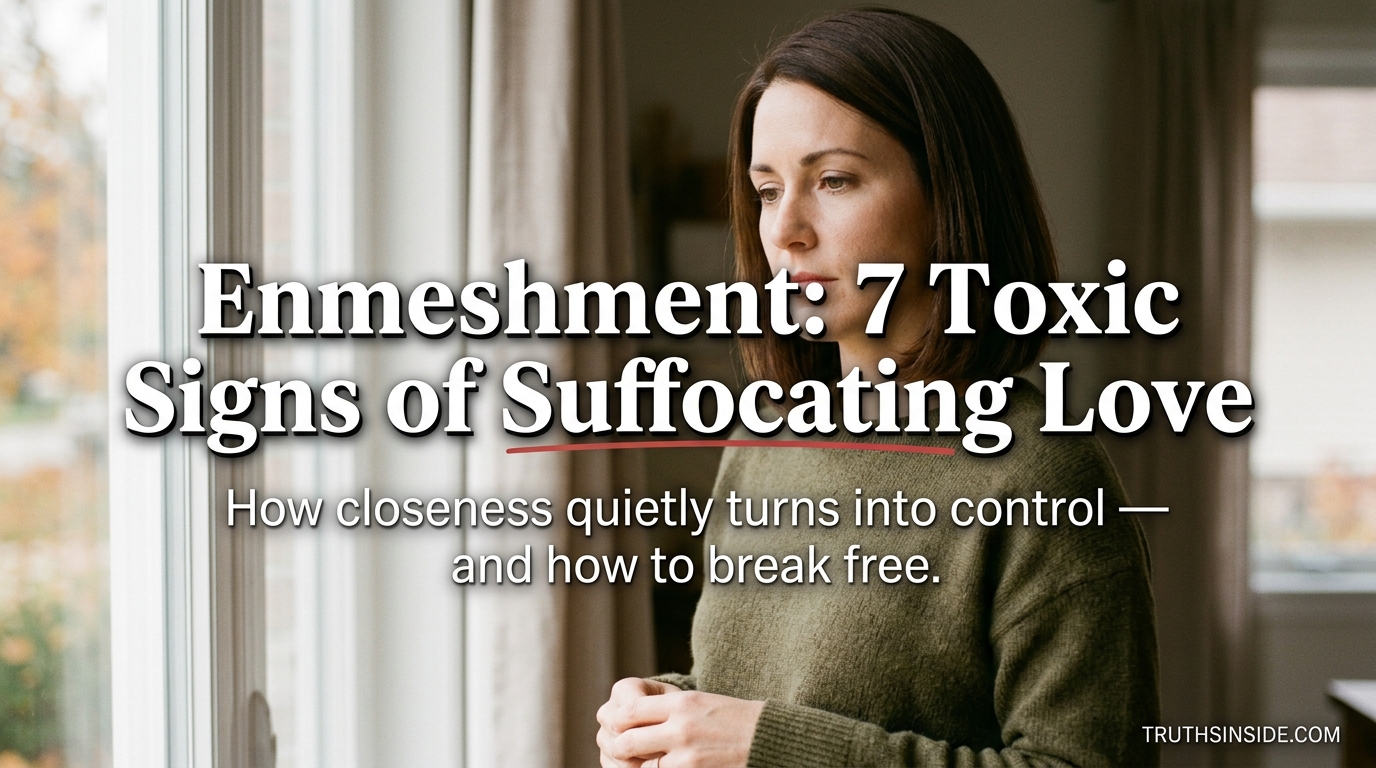
Enmeshment in Relationships: When Closeness Becomes Suffocation
If you have ever felt guilty for wanting a night alone, or panicked when someone you love pulls away for even a day, you already understand the quiet ache of enmeshment. Researchers at the Gottman Institute have long noted that couples and families who never develop separate identities are far more likely to report chronic anxiety and resentment than those who maintain healthy emotional distance. Closeness feels safe until it starts to feel like drowning.
Enmeshment is not the same as love, even though it often wears love’s clothing. It is a pattern where the emotional boundaries between two people blur so completely that one person’s mood, choices, or crises become the other’s automatic responsibility. What looks like devotion from the outside can feel, from the inside, like slowly losing the ability to breathe on your own terms.
This article walks through what enmeshment actually is, how it takes root in families and romantic relationships, the seven clearest signs that closeness has tipped into suffocation, and the psychological cost of staying enmeshed for too long. By the end, you will have language for something you may have felt for years without a name.
What Is Enmeshment, Really?
Enmeshment is a term family therapists use to describe relationships with weak or nonexistent emotional boundaries. In an enmeshed dynamic, individuality is treated as a threat rather than a strength. Family systems theorist Salvador Minuchin first described enmeshment in the 1970s while studying families where children struggled to develop independent identities because their emotional lives were fused with a parent’s needs.
The core problem with enmeshment is not closeness itself. Healthy families and couples are close, supportive, and emotionally available to one another. Enmeshment crosses a line when closeness requires the erasure of a separate self. In an enmeshed relationship, disagreement feels like betrayal, privacy feels like rejection, and personal growth feels like abandonment. The relationship survives only as long as both people stay merged.
This distinction matters because enmeshment often gets mistaken for a strong bond. Friends might even praise an enmeshed parent and adult child for being “so close,” not realizing that the adult child has never learned to make a decision without checking in first. Enmeshment can look beautiful from a distance and feel suffocating up close.
📃 Related article: Discard Phase: 6 Shocking Red Flags to Know Now
The Psychology Behind Enmeshment
Attachment theory offers one of the clearest lenses for understanding why enmeshment forms. Children who grow up with an anxiously attached or emotionally dependent parent often learn early that their job is to manage the parent’s feelings. A child who senses that mom becomes distraught when left alone may unconsciously decide that separation is dangerous. That belief, formed in childhood, quietly shapes adult relationships decades later.
Polyvagal theory adds another layer. When the nervous system associates separation with danger, even healthy independence in a partner can trigger a genuine fight-or-flight response. This is why people raised in enmeshed families often describe real physical anxiety, a racing heart, tight chest, or nausea, when a partner simply wants an evening to themselves. The body has learned that distance equals threat, even when nothing threatening is actually happening.
Enmeshment also thrives in cultures and families that equate self-sacrifice with love. If a household teaches that a “good” partner or child always puts others first, boundaries start to feel selfish. Over time, the enmeshed person stops asking what they want, because the question itself feels like a betrayal of the people they love.
“Enmeshment convinces you that losing yourself is the price of being loved. In reality, it is the very thing love should never ask of you.”
7 Signs Enmeshment Has Replaced Healthy Closeness
Enmeshment rarely announces itself. It builds slowly, one small boundary crossing at a time, until the pattern feels normal. These seven signs tend to show up across enmeshed families, friendships, and romantic partnerships.
1. Guilt is the price of independence. Wanting time alone, a separate hobby, or a night with friends triggers guilt rather than freedom. In enmeshment, autonomy is treated as disloyalty.
2. Emotions are not your own. You feel responsible for regulating another person’s mood. If they are anxious, you must fix it. If they are upset, you must soothe it immediately, regardless of your own needs.
3. Privacy feels forbidden. Enmeshed relationships often lack basic privacy. Phones, journals, friendships, and even thoughts are expected to be fully shared, and secrecy is treated as a moral failure rather than a normal human need.
4. Decisions require approval. Even minor choices, what to wear, what job to take, who to befriend, get run through another person first, not out of respect but out of fear of the emotional fallout if they disapprove.
5. Conflict feels catastrophic. In healthy relationships, disagreement is survivable. In enmeshment, conflict feels like it could end the relationship entirely, so people avoid honesty to protect the bond.
6. Identity blurs with the other person. You struggle to name your own opinions, tastes, or goals separate from theirs. Enmeshment slowly replaces “I think” with “we think,” even in matters that only concern you.
7. Separation triggers real anxiety. Distance, whether physical or emotional, produces genuine distress rather than simple missing. This is often the clearest sign that enmeshment has replaced secure attachment.
Recognizing even two or three of these patterns is common in enmeshed families and long-term partnerships. The goal is not shame, but clarity, because clarity is the first step toward change.

How Enmeshment Develops in Families
Enmeshment often begins in the family of origin, long before a person’s first romantic relationship. A parent who lost a spouse, struggled with mental health, or lacked their own support system may unconsciously lean on a child for emotional stability. The child, wanting to help, steps into a caretaking role far too early. This dynamic, sometimes called parentification, is one of the most common roots of adult enmeshment.
Only children and eldest daughters are statistically more likely to report enmeshed family dynamics, according to family systems research, likely because they are often positioned as the family’s emotional anchor. Over time, the child’s needs become secondary to the family’s emotional equilibrium. By adulthood, this person may not even recognize enmeshment as unusual, because it was simply how love was defined at home.
Enmeshed families also tend to discourage outside relationships. Friendships, romantic partners, and even therapy can be treated as competition for loyalty. A grown child dating someone new might face subtle guilt trips or direct interference, not because the family is malicious, but because the family system depends on the child staying fused to it. Breaking that pattern often feels like grief, even when it is healthy.
📃 Related article: Psychological Safety: 5 Powerful Keys to Vulnerability
Enmeshment vs Healthy Closeness
The line between deep intimacy and enmeshment is not about how much two people care for each other. It is about whether each person retains a self. Healthy closeness allows for two individuals who choose connection daily. Enmeshment requires fusion, where the relationship only functions if both people stay merged.
In healthy closeness, a partner can say “I disagree” and the relationship survives easily. In enmeshment, disagreement feels dangerous, so people either avoid honesty or over-apologize to restore safety. In healthy closeness, alone time strengthens the bond. In enmeshment, alone time is treated as a threat that must be minimized or explained away.
“The healthiest relationships are built by two whole people choosing each other, not two halves desperately trying to complete one another.”
Perhaps the clearest test is this: in healthy closeness, supporting someone’s growth feels natural, even when that growth creates temporary distance. In enmeshment, growth in one person destabilizes the entire relationship, because the system was never built to hold two separate identities in the first place.

The Cost of Enmeshment on Identity and Mental Health
Living inside enmeshment for years takes a measurable psychological toll. Adults who grew up enmeshed frequently report difficulty identifying their own preferences, chronic people-pleasing, and a persistent low-grade anxiety in relationships that should feel safe. Because their sense of self was built around another person’s needs, independence itself can feel disorienting rather than freeing.
Clinical psychologists who study codependency note that enmeshment and codependency frequently overlap. Both patterns involve a diminished sense of self and an outsized responsibility for other people’s emotions. Left unaddressed, enmeshment can contribute to burnout, resentment that has no clear target, and romantic relationships where one partner quietly disappears into the other over time.
There is also a physical cost. Chronic hypervigilance about another person’s emotional state keeps the nervous system in a low-level stress response for years. Over time, this contributes to fatigue, irritability, and difficulty relaxing even in moments of genuine safety. The body, much like the mind, was never meant to carry someone else’s emotional weight as its own.
Children raised in enmeshed households are also more likely to repeat the pattern in adulthood, either by choosing enmeshed partners or by unintentionally recreating enmeshment with their own children. Awareness is what interrupts this cycle, because enmeshment can only survive in silence.
Breaking Free From Enmeshment: Steps Toward Healthy Boundaries
Undoing enmeshment does not mean withdrawing love. It means learning to stay close while also staying whole. The first step is naming the pattern out loud, either to a therapist, a trusted friend, or simply in a journal, because enmeshment loses power the moment it is identified rather than assumed to be normal.
The second step is practicing small, low-stakes boundaries. This might mean not answering a text immediately, spending an evening alone without explanation, or holding an opinion that differs from a parent or partner. These small acts rebuild the muscle of having a separate self, one that enmeshment slowly weakened over time.
Therapy, particularly approaches rooted in family systems work or attachment-focused therapy, can help unravel enmeshment at its root rather than only managing its symptoms. A skilled therapist helps clients tolerate the discomfort of separation without collapsing into guilt, which is often the exact skill enmeshment never allowed them to develop.
Finally, healing from enmeshment requires grieving the version of closeness you believed was love. This can be one of the hardest parts, because it is not simply setting a boundary with another person, it is releasing a belief system about what connection is supposed to feel like. On the other side of that grief is a relationship built on choice rather than fusion.

Frequently Asked Questions About Enmeshment
Is enmeshment the same as codependency?
They overlap but are not identical. Enmeshment describes blurred emotional boundaries between people, while codependency specifically describes an excessive reliance on another person’s approval or wellbeing for one’s own sense of self.
Can enmeshment happen in romantic relationships without a family history of it?
Yes. While enmeshment often begins in childhood, it can also develop in adulthood, especially in relationships that form quickly and intensely, or during periods of loneliness when merging with a partner feels safer than facing uncertainty alone.
How do I set a boundary with an enmeshed parent without feeling like a bad child?
Start small and expect discomfort rather than approval. Enmeshed systems often respond to boundaries with guilt, but consistency, paired with compassion, gradually teaches the relationship a new, healthier pattern.
Can an enmeshed relationship become healthy again?
Yes, particularly when both people are willing to acknowledge the pattern and do the work of individuating. It typically requires patience, and often professional support, but healthy closeness can be rebuilt.
What is the difference between healthy interdependence and enmeshment?
Interdependence means two whole people choosing to rely on each other while maintaining separate identities. Enmeshment means the relationship cannot function unless both people remain fused, with little room for individual thought or need.
If this article helped you recognize a pattern in your own life, save it for the next time you need the reminder, share it with someone who might see themselves in these words, and follow Truthsinside.com for more honest, research-backed conversations about relationships, psychology, and the quiet patterns that shape how we love.
🎵 Music
Maren Lull is a singer-songwriter who writes from the places most people don’t talk about out loud.
Not the dramatic grief. Not the obvious heartbreak. The quiet kind — the ordinary Tuesday emptiness, the habit of reaching for someone who isn’t there anymore, the particular exhaustion of being strong for so long that the strength itself wears thin.
Her music lives at the intersection of emotional honesty and soft beauty — breathy vocals over gentle piano, slow tempos, lyrics that feel less like songs and more like something you wrote in a private notebook at two in the morning and never showed anyone.
Maren Lull writes for the people who feel everything deeply and say very little about it. For the ones who listen to sad music not because they want to feel worse — but because being understood, even by a song, makes the feeling easier to carry.
📱 Follow Maren Lull:
→ Spotify
→ Apple Music
→ Youtube
→ Audiomack